
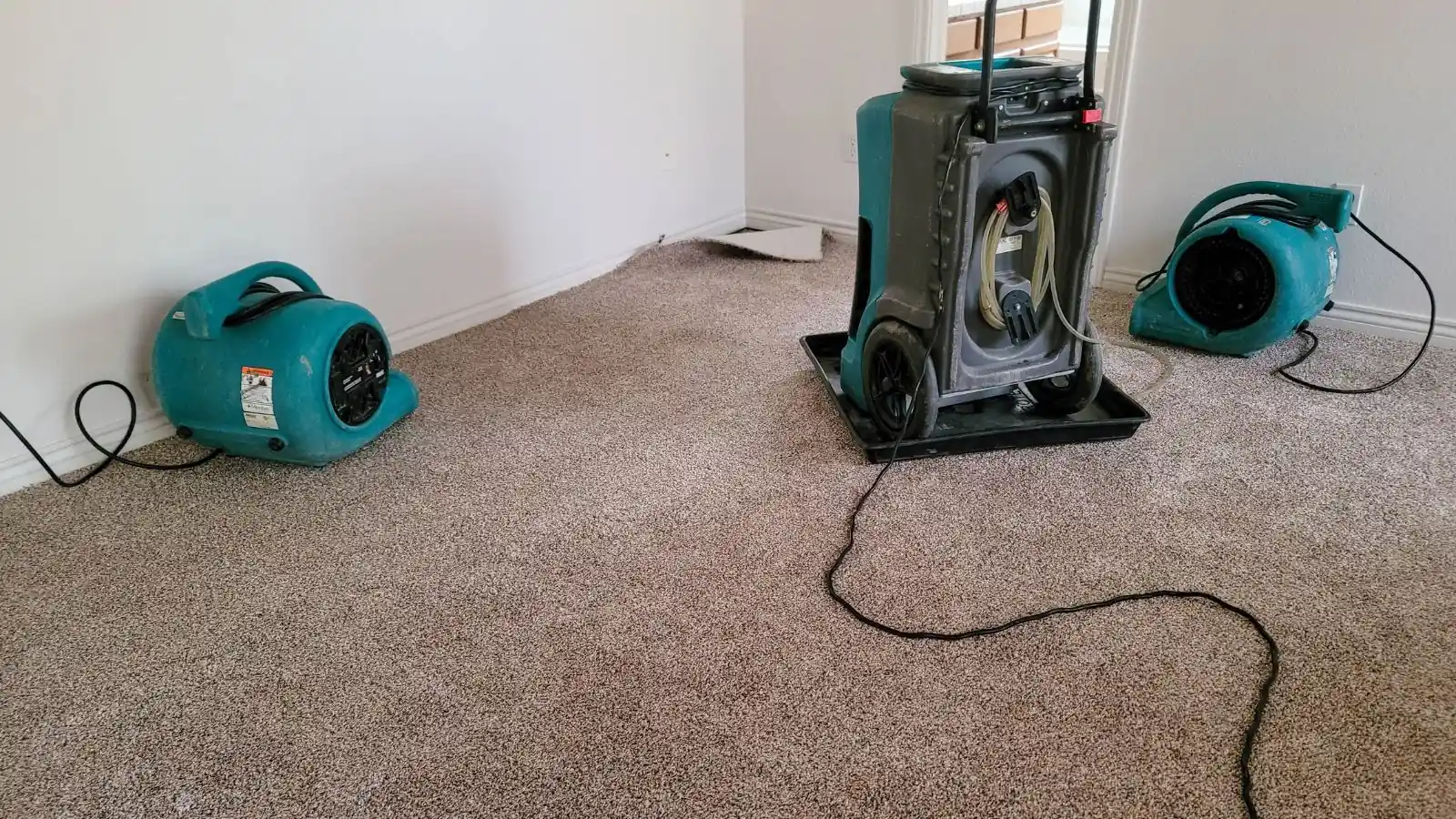
The honest range: days, not hours, and sometimes weeks
After the standing water is removed, a typical room with drywall and carpet often needs about three to five days of equipment. A hardwood floor, a plaster wall or a concrete slab can take a week or more. Heavy losses, humid weather and cluttered rooms add time.
These are ranges, not promises. Every house is different, and every loss has its own mix of materials and moisture. What matters is that readings reach the dry goal, and that goal is measured, not guessed.
How drying works in plain terms
Water leaves materials as vapor. Air movers push air across wet surfaces to speed evaporation. Dehumidifiers pull the vapor out of the air so the air can take more. When the air is dry, the materials keep releasing water until they match their normal level.
That is why a closed room with a dehumidifier dries faster than a room with open windows on a humid day. It is also why fans alone do not finish the job. The ANSI/IICRC S500 standard describes this method in detail.
| Material | Typical drying behavior | Why |
|---|---|---|
| Carpet and pad | Fast surface drying, pad is slower | Open fibers release water quickly |
| Drywall | Days if wet only on the surface | Paper face absorbs and releases water |
| Hardwood floor | A week or more | Dense wood releases water slowly |
| Plaster and lath | Often longer than drywall | Thick material, hidden cavity |
| Framing lumber | Several days to a couple of weeks | Water sits deep in the grain |
| Concrete slab | Weeks for deep moisture | Dense and thick, slow to release |
What slows drying down
- High indoor or outdoor humidity, common in a New Jersey summer
- Contaminated water that requires removal of materials before drying
- Wet materials hidden behind finished surfaces that have not been opened
- Layered floors, such as vinyl over plywood over subfloor
- Low temperature, which slows evaporation in cold basements
- Equipment turned off early or doors left open in the drying area
Seasons and older homes in Rahway
Rahway has four seasons, and drying is slower in damp summer air than in a dry heated winter house. The ACS puts the median build year for Rahway housing at 1961, so many homes have plaster walls, older subfloors and basements with little ventilation. If your loss happens in July in a plaster-walled house, plan on the longer end of the range and ask for daily readings so you can see progress instead of waiting on a guess.
How we know it is dry
Set the goal
We take readings from unaffected materials in your home. That gives a dry reference for each material.
Measure on day one
We record moisture, temperature and humidity at marked spots.
Re-measure daily
We check the same spots each visit and adjust equipment.
Release the equipment
When readings match the goal, equipment leaves. Not before.
Why feeling dry is not the same as being dry
A baseboard can feel dry while the wall behind it is wet. A floor can look flat while the subfloor holds water. Wet materials hide behind paint, tile and carpet. A moisture meter and thermal camera look through those layers.
Closing the walls or laying new flooring too early traps moisture and invites mold. That is a common mistake after a leak. When a contractor asks whether the area is ready, a log of readings is the best answer.
What you can do to help
Keep the drying area closed and keep equipment running. Move belongings out of the way and keep cords clear. Avoid opening windows unless the crew says so. Report any new stains, smells or sounds.
If a room is part of a larger loss, ask how the crew will split the house into drying zones. For extraction details before drying, see water extraction. For floors, hardwood floor water damage repair explains the slower timeline.
When drying should have been done sooner
If a leak was found days after it began, the wet area is larger and the drying takes longer. Materials that stayed wet for more than a couple of days may need removal. This is one reason we ask for early calls, even when the leak seems small.
Homeowners in Clark and Woodbridge ask the same question after storms, and the answer is the same: the readings decide.
Timelines by common loss type
| Loss | Typical drying plan | Watch for |
|---|---|---|
| Kitchen supply line leak | Several days with air movers and a dehumidifier | Cabinet bases and subfloor under the sink |
| Washer hose failure | Three to five days, longer if two floors are wet | Ceiling below and wall cavities |
| Basement groundwater | A week or more | Concrete, block walls and framing near the floor |
| Roof leak into a ceiling | Several days after the roof is fixed | Insulation and joists above the ceiling |
| Hardwood floor spill | One to two weeks of controlled drying | Cupping and gaps after drying |
Treat these as starting points. A shallow spill on a sealed floor can dry in a day, while a slow leak in a plaster wall can take weeks. The record that matters is the daily reading log.
Why drying equipment sounds loud and runs for days
Air movers and dehumidifiers work continuously because water leaves materials slowly and steadily. Turning them off overnight lets the air rehumidify and slows the whole job. The noise and heat are a trade for a shorter total time.
If the noise is a problem, tell the crew. They may be able to move units, change the schedule or reduce the number of machines once the first days pass. Do not unplug a unit without telling us, because the readings that follow will reflect it.
Planning your life around a drying job
Expect equipment in your home for several days and a few visits from the crew. Plan for noise, extra power use and some rooms being off limits. If you work from home, tell us, and we can position units to keep your workspace usable.
Pets and children should stay clear of cords and machines. Keep valuables out of the drying area. If you must move out for a short time, ask your insurer whether additional living expenses are covered. Tell the crew if you will be away so they can arrange access.
Signs drying is not finished
A musty smell that comes back, paint that bubbles, floors that keep cupping and humidity that stays high in a closed room are all signs that something is still wet. Call for readings rather than waiting for the problem to grow.
What to do while materials dry
These steps help drying and protect your claim.
- Keep wet rooms closed in and the air moving.
- Do not turn up the heat to rush drying.
- Do not cover wet floors or walls until readings are dry.
- Keep a log of dates, photos and readings.
- Call a crew if a room still feels damp after a few days.
Drying time questions in Rahway
Often about three to five days for drywall and carpet, and longer for hardwood, plaster or concrete. Daily readings tell you when each material is done.
Fans help, but dehumidifiers matter more. Keep the area closed, and let a crew set equipment where it works best.
Concrete is dense and cold, and basements often have little airflow. Desiccant dehumidifiers and patience are common solutions.
Often yes, because humid air holds less extra moisture. More dehumidification is used in summer to compensate.
Readings from the wet area match readings from dry, unaffected materials of the same type. We share the log with you.