
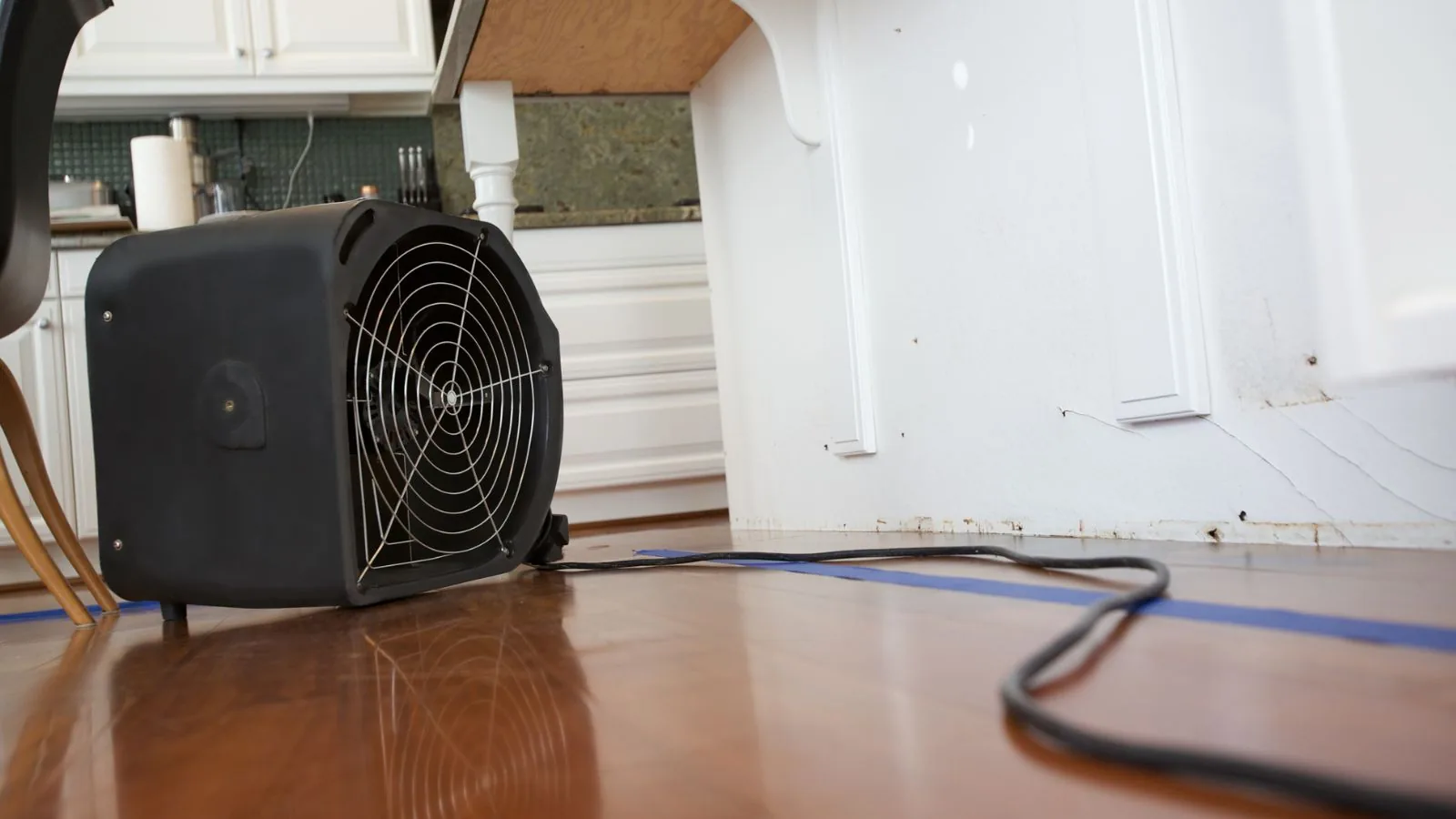
Why kitchens are hard to dry
A kitchen hides water well. Cabinet boxes sit on a toe kick that traps moisture, the dishwasher blocks the floor along one wall, and sheet flooring may sit over layered underlayment. Water that begins at a sink trap can travel under cabinets into a neighboring room before a stain appears.
Because of that, we do not judge a kitchen by its surface. We read moisture at the cabinet base, behind the dishwasher and at the baseboards, then open only the areas that read wet.
| Kitchen material | How it reacts to water | Usual approach |
|---|---|---|
| Particleboard cabinet base | Swells and loses strength | Often replaced if saturated |
| Solid wood or plywood cabinet | Can often be dried | Dry in place after extraction |
| Vinyl or laminate flooring | Water gets under seams | Lift sections, dry the subfloor |
| Tile over backer board | Grout lets water through | Check backer, dry or replace |
| Drywall behind cabinets | Wicks water upward | Cut and dry if wet |
What we do in a wet kitchen
Stop and extract
After the source is closed, we pull standing water with wand extractors. See water extraction for details.
Open the cabinet bases
Removing toe kicks and a section of baseboard lets air reach the space behind.
Dry the layers
Air movers push air under flooring and behind cabinets while a dehumidifier lowers humidity.
Confirm dry readings
We log moisture daily and release the kitchen when each material hits its goal.
Rahway kitchens often sit on older plumbing
With a median build year of 1961 in the ACS figures for Rahway housing, many kitchens still have original supply stops and drain traps beneath newer countertops. Old stop valves can seize or drip when turned. Have your plumber test the sink shutoffs and replace any that stick, since you will need them to work the next time something fails.
Kitchen safety first
Turn off the power to a wet kitchen at the breaker if outlets or the stove area are in the water. Do not use a refrigerator that sits in water. Gas ranges need a technician after a flood before you relight them.
Common kitchen leak sources and quick checks
Open the cabinet under the sink and look for water at the trap, the supply stops and the garbage disposal seals. Feel the underside of the countertop near the faucet. Check the floor in front of the dishwasher and the area behind the refrigerator where the icemaker line runs.
A leak that appears only when the dishwasher runs points to its drain or inlet. A leak that appears only when the sink is used points to the drain or faucet. Knowing which helps the plumber and helps us decide where the water went first.
Protecting what remains while you wait
Move dry goods out of the lower cabinets and place a towel or tray under any slow drip. Lift rugs and mats so air can reach the floor. Do not leave a wet-dry vacuum running unattended near outlets, and keep children out of a kitchen with wet flooring.
If the leak came from a line that serves the refrigerator, check food safety. Items that sat in warm or wet conditions should be judged on temperature and contamination, not appearance.
Granite and quartz tops are rarely harmed by water, but the particleboard under them can be. When we lift a sink or pull a cabinet, the countertop may need support or removal. Let the cabinet contractor handle that step after drying, so the stone is not cracked while it is moved.
What affects kitchen water damage cost
- Cabinet material. Solid wood often dries, while particleboard may need replacement.
- Flooring type. Floating floors lift and dry quickly. Glued-down vinyl and tile take more work.
- Reach of the water. Water that crossed into a hallway or dining room expands the drying area.
- Appliances. Moving a refrigerator or range adds setup time.
The standard behind kitchen drying
We follow the ANSI/IICRC S500 water damage standard as our reference for deciding which cabinet bases, flooring and wall cavities can dry in place. It is a published industry document and not a certification claim.
Rebuilding after drying
Once readings show dry, a contractor can reinstall cabinet faces, flooring and paint. We recommend asking whether new cabinet bases can be made water-resistant, and whether the dishwasher can get a leak pan. If the leak began in the machine, read appliance leak water damage.
If water spread to a floor below, see hardwood floor water damage repair. We serve Roselle Park and the other nearby towns with the same kitchen drying approach.
Kitchen water damage questions
Solid wood and plywood often can, if they are dried quickly. Particleboard swells and may not return to shape. We measure first, then tell you which cabinets can stay.
Often yes, at least pulled forward. Water commonly sits under and behind it, and the subfloor there needs a reading and drying.
Once the area reads dry and any removed pieces are replaced. We tell you when readings reach goal. Using a wet kitchen early can leave moisture trapped.
It can if moisture stays. Quick drying prevents that, and we recommend remediation if growth is visible.