
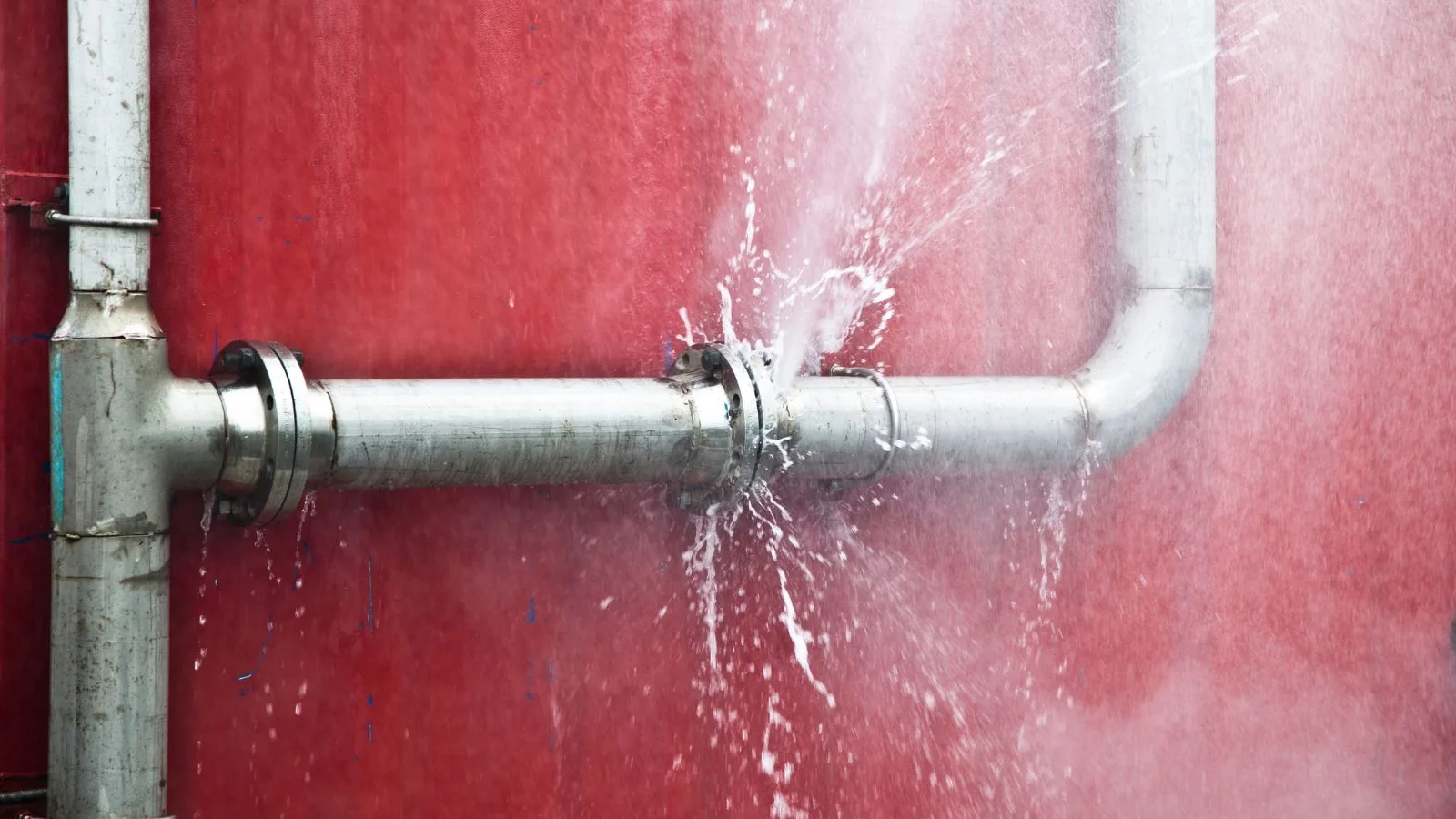
The first ten minutes of a burst pipe emergency
Find the main shutoff and close it. In many Rahway homes it sits near the meter in the basement or utility room. Turn the handle fully, then open the lowest faucet to let the pipe drain and lower the pressure behind the break.
Once the flow stops, step back from the wet area. Water that reached outlets, a ceiling light or an appliance base can carry current. If the ceiling is bulging or dripping, place a bucket and keep away from the sagging section until it has been checked.
What we do after the water stops
Extract standing water
Pumps and wand extractors remove what sits on floors and in carpet. See our water extraction page for the equipment.
Open the affected cavities
A small inspection hole or a flood cut lets us see whether the water is trapped behind drywall or above a ceiling.
Dry the structure
Air movers and dehumidifiers run until readings match dry reference materials in the same home.
Document the loss
We record moisture readings and photographs that your insurer may ask for. Check your policy for how it treats sudden pipe failures.
Where burst pipes hide damage
A split in a wall pipe soaks the bottom plate and insulation long before a stain appears. A break above a ceiling fills the cavity between joists, then finds the lowest point, which is often a light fixture. Water in a basement ceiling can travel along a beam to an unrelated room.
That travel is why we measure past the visible edge. A room that looks damp at the baseboard may be wet two feet higher inside the wall. Thermal imaging narrows the search so we open only what needs opening.
| Pipe location | Where water usually shows | What we check |
|---|---|---|
| Inside an exterior wall | Baseboard, floor edge, basement ceiling below | Wall cavity, insulation and bottom plate |
| Between floors | Ceiling stain, light fixture, drywall seams | Joist bay, subfloor and fixtures |
| Under a slab or floor | Warm spot, damp carpet, musty smell | Subfloor moisture and flooring layers |
| Basement or utility area | Pooling near the wall, wet boxes | Lower wall sections and stored contents |
Older Rahway homes and aging supply lines
Census Bureau ACS figures put the median year built for Rahway housing at 1961, across about 12,811 units. That means many supply lines have decades of use behind them, and some homes have mixed pipe types from different repairs. If your plumber finds a section that looks corroded, ask whether neighboring runs should be checked at the same visit, since a failure often points to the age of the whole line.
Why supply pipes fail in the first place
Copper can develop pinholes after years of water flow, galvanized steel rusts from the inside and narrows until pressure finds a weak joint, and plastic fittings can crack at a stressed connection. Freezing splits any of them. A plumber can tell you which failure you have and whether the rest of the run is sound.
Water hammer, the bang you hear when a valve shuts fast, adds stress at elbows and joints over time. A failed washing machine hose is not a pipe failure in the strict sense, but it releases water the same way, and it is covered on our appliance leak water damage page.
Save any piece of pipe the plumber removes. Your insurer may want to see it, and it helps the plumber explain what happened. Photograph the break and the first wet areas before cleanup begins. Those images, along with our moisture logs, give an adjuster a clear timeline of the loss.
What affects burst pipe cleanup cost
- How long it ran. A line caught in minutes soaks far less than one that ran overnight.
- Rooms and floors reached. Water that traveled through two floors needs equipment in both.
- Materials involved. Plaster, drywall, insulation, carpet and hardwood each dry or fail differently.
- Access to the wet cavity. Finished ceilings and tiled walls take more care to open and close.
What to do before help arrives
These steps limit damage while you wait.
- Shut off the main water valve if you can reach it safely.
- Turn off power to wet areas only if the breaker panel is dry and you can reach it without standing in water.
- Move furniture, rugs and electronics out of the wet area.
- Photograph the damage and the pipe before anything is moved.
- Stay away from ceilings that sag or bulge.
Standard we follow for burst pipe losses
Our drying plans use the ANSI/IICRC S500 standard as the reference for water category and drying goals. A fresh supply line break is usually clean water, but time changes that. The EPA advises drying wet materials within 24 to 48 hours to limit mold.
After the cleanup
Once the structure is dry, repairs can begin. Drywall, paint and flooring replacement are normally scheduled with your contractor. If the break happened in cold weather, read about frozen pipe water damage to learn what freezing does to the rest of the line.
If water also reached carpet, our carpet water damage restoration page covers the options. We serve Roselle Park and the other nearby towns the same way, and the process is the same in each.
Burst pipe questions homeowners ask
Yes. Burst pipes do not wait for business hours, so the line at (732) 352-9660 stays open day and night. Shut off the main valve, call us, and we arrange a crew for water removal and drying.
No. We handle extraction, drying and cleanup. A licensed plumber repairs or replaces the pipe. Many homeowners call both at once so the pipe is fixed while the water is being removed.
Many homeowners policies treat sudden pipe failures differently from long-term leaks, but terms vary. Read your policy or ask your insurer. We keep moisture readings and photos so you have the documentation.
A moisture meter and thermal camera can read through finished surfaces. If water ran inside a wall, the reading rises well before paint bubbles. That is why we measure instead of guessing.