
Signs your home still needs drying: musty smell, damp walls and cupping floors
A room can look fine and still be wet. Warning signs include a musty odor that returns after cleaning, baseboards that feel cool or damp, paint that bubbles, wood floors that cup or crown, and condensation on windows in a room that was recently flooded.
These signs mean moisture is still trapped in materials. If you see them days after a leak, call for readings. Drying late is slower and can cost more, but it is far better than leaving a wet cavity closed up behind new paint.
How structural drying works
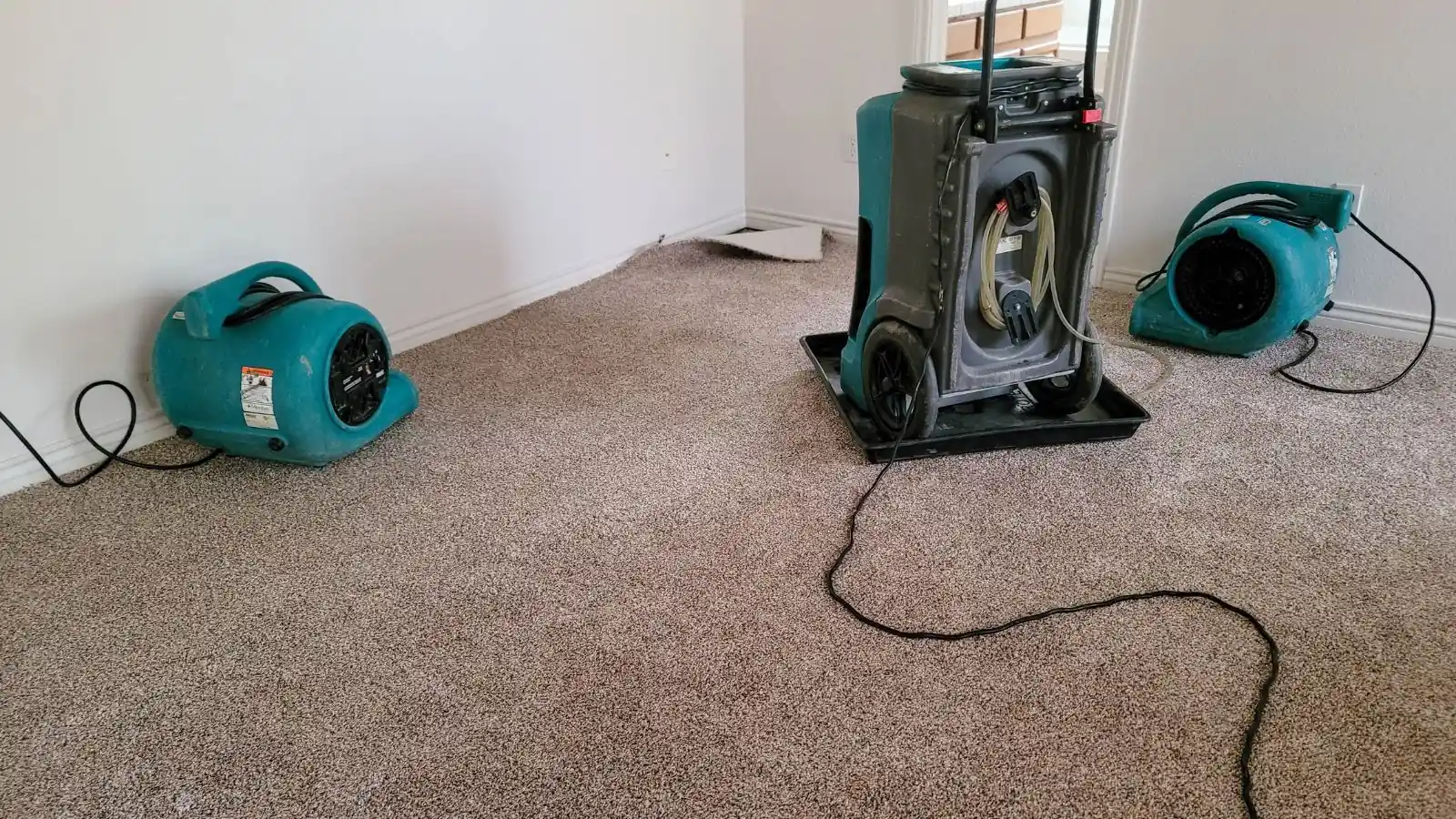
Drying follows the science of psychrometrics. Water leaves a material as vapor, and the air must be able to hold it. Air movers speed evaporation at the surface, and dehumidifiers remove the vapor so the air stays dry enough to take more.
The ANSI/IICRC S500 standard describes this approach. We set drying goals from dry reference readings in the same home, run equipment and measure again each day. Equipment comes out only when the readings match.
Map the moisture
Moisture meters and a thermal camera show wet areas, and we mark them so we can track progress.
Build the drying chamber
We close off the wet area, so the dehumidifiers work on that space and not the whole house.
Place equipment
Air movers, LGR dehumidifiers and sometimes desiccant units are placed based on room size and wetness.
Measure daily
We log temperature, humidity and moisture content, then adjust equipment until goals are met.
| Equipment | Job | When it is used |
|---|---|---|
| Air mover | Moves air across wet surfaces | Floors, lower walls, carpet |
| LGR dehumidifier | Pulls vapor from the air | Most residential drying |
| Desiccant dehumidifier | Works well in cool or very damp conditions | Cold basements, large losses |
| Injection drying system | Pushes air into cavities or under floors | Hardwood and wall cavities |
| Thermal camera and meter | Shows hidden moisture | Start of job and every visit |
Why older Rahway houses dry differently
The ACS puts the median build year for Rahway housing at 1961, so many houses have plaster walls, solid sheathing and older subfloors. Those materials hold water differently from modern drywall, and they can take longer to dry. We measure plaster and framing individually and plan equipment time around the slowest layer in the wall, not the fastest.
During drying
Equipment runs on household power and adds noise and heat. Keep the cords out of walkways, do not turn equipment off to save power and call us if a unit stops. Keep doors closed on the drying area so the dehumidifiers can do their job.
Why we measure instead of guessing
Touch tells you very little about moisture inside a wall. A moisture meter reads the water content of wood and drywall in numbers, and a thermal camera shows cool, wet areas as color. Together they let us set a start point, a goal and a daily record.
The goal is the dry standard, which is the reading of the same material in an unaffected part of your home. A damp wall is compared to a dry wall nearby. When the numbers match, the structure is dry, and the equipment can leave.
Common drying mistakes
Turning off equipment early because the room feels dry is the most common mistake. Closing up walls or laying new flooring over damp subfloor is another. Running a household fan alone without a dehumidifier moves moisture around but does not remove it.
Opening windows on a humid day can slow drying, since outdoor air may hold more moisture than indoor air. Keep the drying area closed, keep the equipment running and let readings, not feelings, decide when it is finished.
What affects drying time and cost
- Material. Hardwood, plaster and concrete dry more slowly than carpet or drywall.
- Water category. Contaminated water adds removal, which also changes the drying zone.
- Size and layout. Open rooms dry faster than a series of small closed spaces.
- Weather. Humid New Jersey summers slow evaporation, so more dehumidifier capacity is used.
What to do while drying equipment runs
The equipment only works if the space stays closed in.
- Keep doors and windows closed in the drying area.
- Leave equipment plugged in and running, and do not move hoses.
- Keep children and pets away from fans and cords.
- Keep a note of any new odors, stains or damp spots.
- Call us before anyone cuts, paints or covers wet materials.
Where drying fits in the larger job
Drying follows water extraction and, if needed, the removal of damaged materials. For floors, see hardwood floor water damage repair. If dampness lingers and a musty smell persists, mold remediation may be the next question.
We also run drying jobs in Roselle Park and the other nearby towns.
If you think your home is still damp
Look for cool, damp baseboards, bubbling paint, a musty smell or warped trim. A moisture meter and thermal camera give a better answer than touch, because wet cavities can feel dry on the surface.
Many residential jobs take several days, but heavy losses and slow materials like hardwood or plaster take longer. We measure daily and remove equipment only when readings match dry goals.
Fans move air but do not remove moisture. Dehumidifiers pull the vapor out of the air, which lets the materials keep releasing water.
Yes, equipment uses power during the drying period. The cost is usually small compared with the repair cost of a wet structure. Ask your insurer whether it is part of a claim.
Equipment alone is not enough, because drying needs readings from moisture meters and adjustments each day. Air movers push air across wet surfaces and dehumidifiers pull moisture out of the air. Drying time depends on the materials and how wet they are, so we measure and adjust.